Chapter 3: Into the Wilderness: Giolitti in Opposition, 1894–1901
Key figures
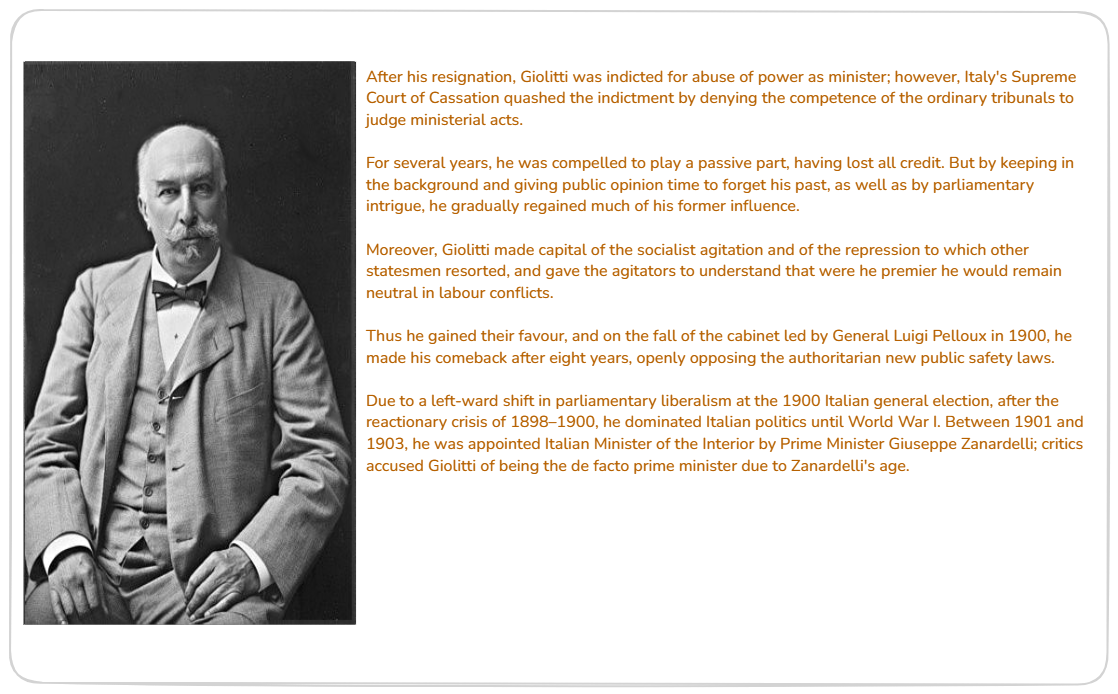
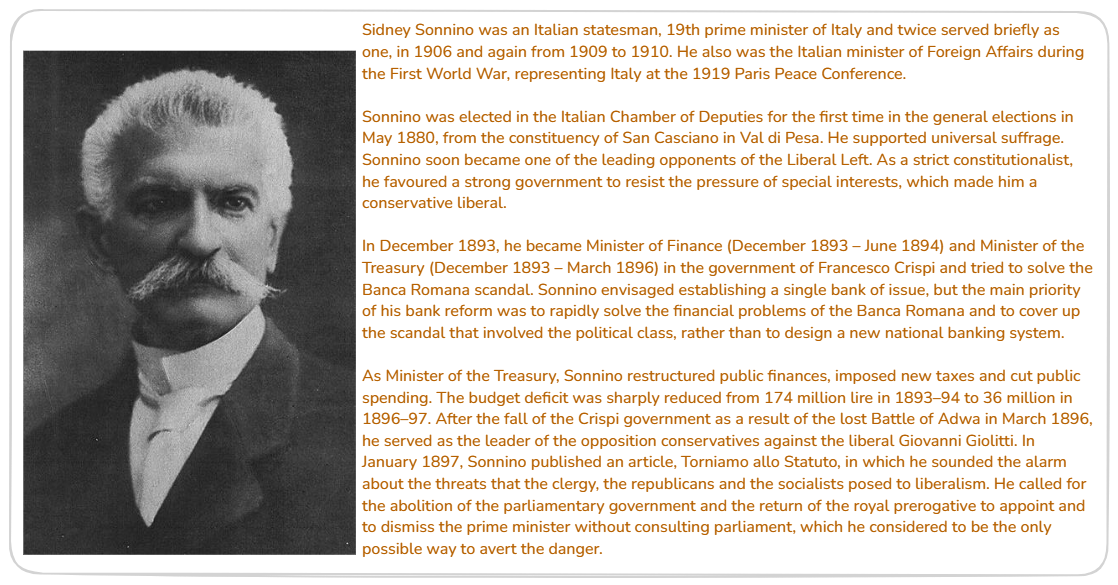
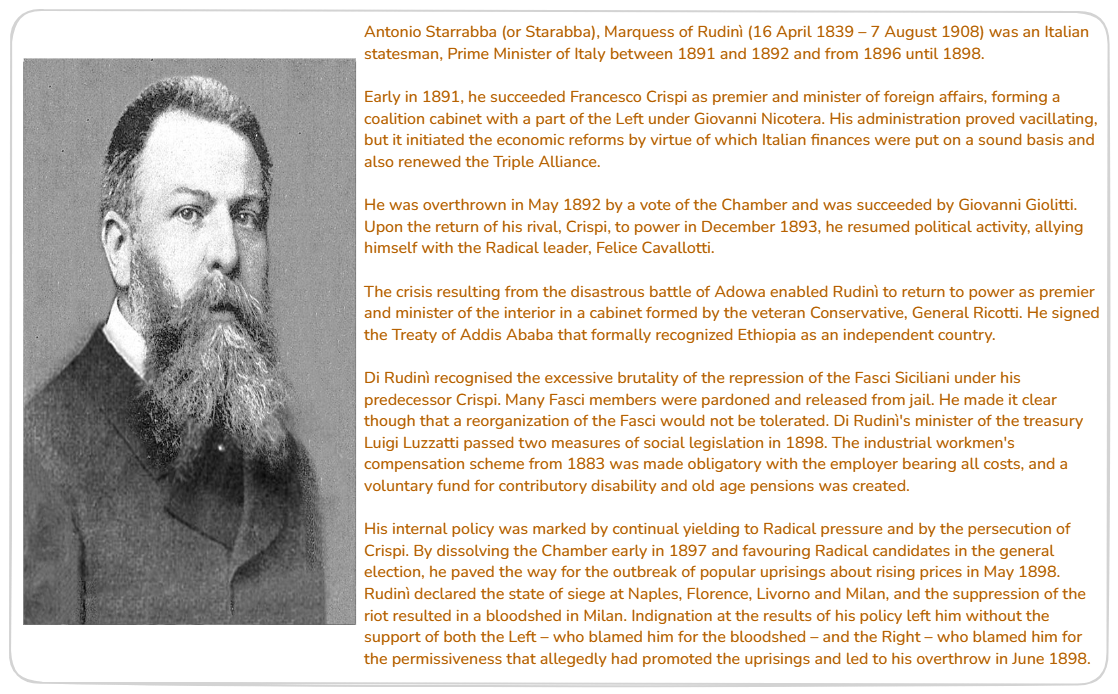
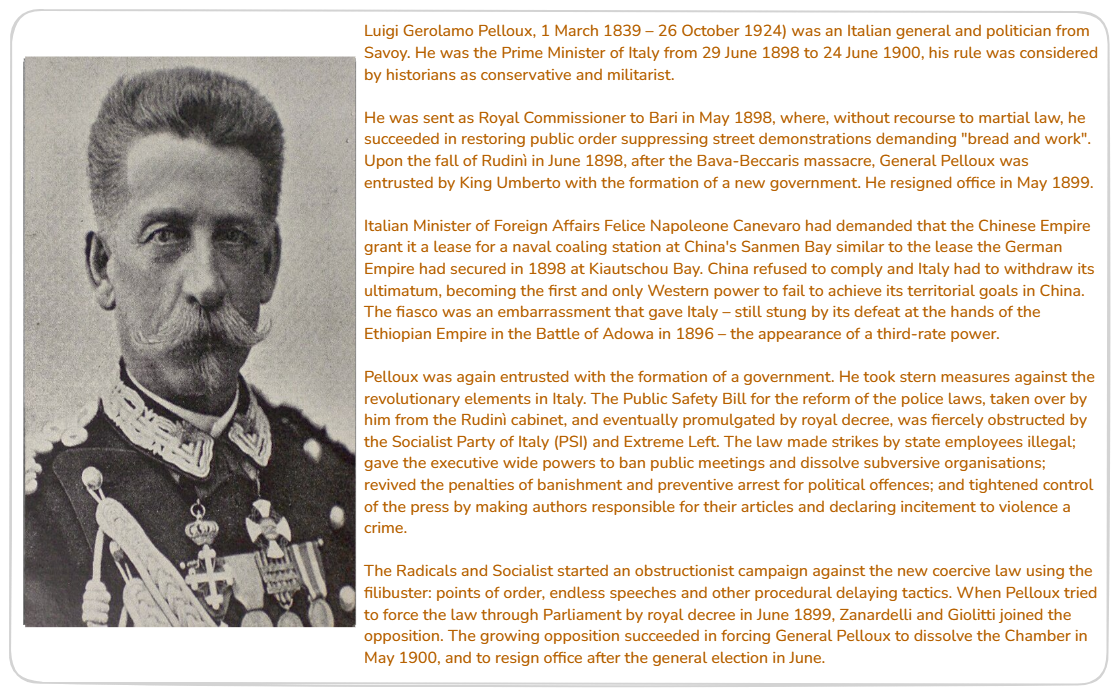
From Giolitti to Crispi
Giolitti faced the most difficult period in his long political career during the two years after the end of his first administration. Events had negated his moderate course in domestic politics, but the personal attacks were even worse. It was almost as though the political system had decided to expel the outsider. A few lines to his daughter Enrichetta reveal his mood of deep dejection: “I won’t speak of politics to avoid running the risk of becoming pessimistic. Certainly, if I don’t become so now, I won’t [ever] run such a risk.”¹ Former political allies kept their distance from a man whose career seemed over. Relations between Giolitti and Giuseppe Zanardelli cooled considerably when the Zanardellians quickly abandoned Giolitti. In contrast, conservatives Luigi Luzzatti and Antonio di Rudinì never joined the chorus of attacks on Giolitti.²
With Rudinì’s group on the right and the Giolittians on the left out of the picture, much uncertainty existed about the future direction of politics. The majority that Giolitti worked so hard to create collapsed when 190 of the 371 ministerial deputies passed over to Francesco Crispi. By the eve of the 1895 elections, Crispi had the backing of 288 deputies to the opposition’s 164. Of the 190 crossovers, 120 came from the left, 60 from the center-right, and 10 from the right. The initial opposition came from the supporters of Giolitti and Benedetto Brin in Piedmont, Zanardelli’s followers in Lombardy, and Pietro Rosano’s group of Neapolitans; Rudinì, Giulio Prinetti, and Giuseppe Colombo formed the conservative opposition of about twenty.³
The degree to which Crispi resented Giolitti was surprising. The latter’s initial positions in parliament offered ample room for a rapprochement. In contrast to Zanardelli, Giolitti supported Crispi’s repressive policies in Sicily, although he had a harder time backing Sidney Sonnino’s financial measures.⁴ Two major banks, the Credito Mobiliare and the Banca Generale, collapsed between November 1893 and January 1894. To avoid a crisis of the entire system, Sonnino authorized the three issue banks to increase the money supply, enlarge their reserves, and pay a special tax on the excess issue of notes. In February he suspended conversion of notes for gold and forced the banks to hold large bullion reserves at the disposition of the Treasury. Tax increases on grain, land, and inheritances followed. Giolitti gradually made clear his opposition. In June he joined Zanardelli and the left in an unsuccessful effort to pressure the government into budget cuts to ease the impact of tax increases.⁵
The Banca Romana Trials
The surprising acquittal of Bernardo Tanlongo and the other Banca Romana defendants in July 1894 freed Crispi to engage in open warfare against Giolitti.⁶ Crispi instructed his justice minister to open an investigation on evidence tampering by the top police official of Rome, Odoardo Felzani, and the Public Security agents who in January 1893 had gone to the Tanlongo and Lazzaroni residences, but the real targets were Giolitti and Rosano. Fearing just that, Giolitti appealed to the king to have the attacks stopped and defended his actions in a letter to his constituents. He intimated that any missing documents had been hidden away by the Tanlongo family. The noose around Giolitti tightened considerably during the trial of Felzani in October 1894. A new appeal to the king was met with deafening silence.⁷ Giolitti then wrote to the trial court on October 25, 1894, that compromising documents involving several politicians had come into the possession of the Interior Ministry, but not through Felzani. This letter raised the stakes considerably. The documents in Giolitti’s possession were certainly those that the Tanlongo family were exchanging for leniency.⁸
That Giolitti’s file contained material directly involving Crispi and his wife was widely known, but the fact that no one knew exactly what Giolitti had increased the tension. In June, Senator Baldessarre Odescalchi told Domenico Farini that he had seen Giolitti with documents. Giolitti’s friend Antonio Cefaly tried to force the Chamber of Deputies to publish a folder of documents that Giolitti had earlier turned over to the Commission of Seven, but was cut off. The possibility that Giolitti would use this material if driven to the wall worried a number of political figures. Nonetheless, the government showed no hint of backing down from plans to have Giolitti tried before the High Court.⁹
After consulting with deputies from all parts of the Chamber, Giolitti dramatically deposited the packet of documents on the desk of the president of the Chamber on December 11. Observing the scene, Alessandro Guiccioli understood what was at stake: “From one side I hold it impossible that Crispi, with his calm and cold bloodedness, would allow himself to be caught in a trap; on the other side it seems to me improbable that Giolitti would have wanted to menace everyone with an empty pistol.”¹⁰ Giuseppe Biancheri, president of the Chamber, refused to take possession of the material. Felice Cavallotti, Napoleone Cola-janni, and Renato Imbriani of the Estrema demanded that the contents be read. Crispi wanted the documents returned to Giolitti without being opened. Crispi’s ally Onorato Caetani di Sermonetta raised the tone by shouting that Giolitti was “a Bolognese mortadella, half ass and half pig.” The Chamber finally delegated a committee to examine the material.¹¹
On December 13, 1894, the situation became more complicated. The Committee reported on the contents of the packet. Most of the material dealt with the Banca Romana, but there was enough on the financial and political dealings of Crispi and his wife to cause major embarrassment.** Also tarred were Giolitti’s former colleagues, Bernardino Grimaldi, Pietro Lacava, and Ferdinando Martini. Crispi then sued Giolitti for libel, and two days later the parliamentary session closed. At the beginning of 1895, Crispi ==dissolved the Chamber of Deputies and called new elections, thereby removing Giolitti’s parliamentary immunity.==¹² Elections run by Crispi might result in a new parliament that would refuse to claim jurisdiction over Giolitti’s case and allow a trial in regular courts. Fearing that he might be arrested before having a chance to organize his defense, Giolitti left in late December on a two-month trip to Germany, ostensibly to visit his daughter Enrichetta and her new husband, who had just established themselves in Berlin. He returned in February, after the warrant to appear for trial was served.
Giolitti’s political career hit bottom. In a gesture that probably brought more worry than relief, Rosano assured Giolitti that if he was not also indicted, he would be proud to serve as a member of Giolitti’s defense team.¹³ The king’s attitude also troubled Giolitti’s friends. A word from the monarch could have stopped Crispi’s vendetta. Apparently Umberto did work with Giuseppe Saracco to block elections but lost his nerve at the last moment, when Crispi found out. Then the monarch cast his lot completely with Crispi, whom he believed would emerge stronger after the elections.¹⁴
On February 13, 1895, Giolitti was informed by his wife that he had been served with a warrant to appear in court on February 23. In early February, Rosano wrote that Felzani and the other agents would be convicted without even hearing the supporting testimony of Giolitti, and himself, and he urged Giolitti to return.¹⁵ On March 1, the trial judge in the sezione d’accusa rejected Giolitti’s argument that the courts had no jurisdiction. Giolitti’s lawyers immediately appealed to the Court of Cassation, which reversed the lower court and returned jurisdiction to parliament on April 24.¹⁶
The 1895 Elections, the End of the Banca Romana Affair, Crispi's Fall
The composition of the Chamber of Deputies changed considerably as a result of the elections of May–June 1895. In preparation for the voting, the rolls were drastically purged of suspect voters. A law in 1894 called for drawing up entirely new voting lists. As a result, the number of eligible voters fell from 2.9 million to 2.1 million. The South was particularly hard hit by the vetting. In the new Chamber the ministerial supporters numbered 334, and the constitutional opposition (Giolitti, Zanardelli, Rudinì, and a few others) was reduced to 104. The Radicals had forty-seven seats; the Socialists, fifteen. Giolitti was not seriously challenged in Piedmont but allies like Luigi Roux were, as were the Zanardellians and Rudiniani. Still, all the major leaders of the opposition—Colombo, Giolitti, Zanardelli, Brin, Cavallotti, Imbriani, Colajanni, Enrico Ferri, Rudinì, Salvatore Barzilai—returned to Montecitorio.¹⁷
Sonnino’s role diminished as the financial crisis eased and Crispi’s last cabinet concentrated on foreign policy. The governor of Eritrea, General Oreste Baratieri, pushed an expansionist policy in Ethiopia that culminated in a disastrous Italian move into Tigre province in October 1895. Against this background of tension in East Africa, the battle against Giolitti shifted back to the new Chamber of Deputies. ==Farinini, the Senate president, tried to stop a trial before the Upper Chamber by explaining to both the king and Crispi that Giolitti, with his back to the wall, would involve everyone.==¹⁸
When parliament reconvened in November, Giolitti, after a year’s absence, returned to press his case. His determination was clear in a letter to Giuseppe Marcora: “This evening I am going to Rome in order to be at the first session. I am completely ignorant of what the Ministry might do against me, but it seems to me probable that it will immediately present the acts that regard me and want to resolve it on its own terms with a coup by the majority.”¹⁹ In fact, pro-government forces controlled the commission created to examine Giolitti’s case. On December 12, Giolitti asked it to hear all his evidence, which had never been presented to the court, or to allow the full Chamber to do so. When the president of the commission seemed reluctant, Imbriani and Cavallotti sided with Giolitti. ==Tancredi Galimberti moved that Giolitti be allowed to present his defense.==²⁰ During the ensuing debate, the former prime minister defended his record from January 1893 onward and called the entire affair a political persecution. Saracco countered for the government that Giolitti was trying to shift the ground from legal questions to politics, but even he admitted that Giolitti’s appeal to the Chamber had some effect. In the end the Chamber passed a motion that ==accepted the decision of the Court of Cassation and abandoned plans for a trial before the Senate, effectively ending three years of warfare against Giolitti.==²¹
Lessons from a scandal
The crisis deepened certain character traits in Giolitti: self-reliance, pessimism about human nature, and a deep suspicion of public opinion and mass movements. He counseled his daughter Enrichetta to distrust “enthusiasm,” which “in political affairs serves only to make, and to make others make, stupidities”:
Remember, then, that the destinies of nations are never decided by the action of a [single] man, unless everything is prepared in such a way that it is enough to give a signal to start a movement, a transformation; many times credit is given to one who is only an instrument, a standard-bearer.
His own experience of recent years confirmed his doubts about the wisdom of public opinion and the durability of political loyalties: “As for me, I found myself alone against the government, the entire press, the Masonry, the clericals. Who helped me? No one.”²²
Writing to Enrichetta a few weeks later, Giolitti came as close to expressing the basis of his progressive conservatism as he ever would:
The fault of the extreme parties is exaggeration, forgetting that what is exaggerated is false and that which is false has no value. You and Mario [Chiaraviglio] start for the most part from the concept of what men should be, then from what a government should be, and when you see a government that does not respond to this ideal, you would like to bring it down.
Get this in your head, men are what they are in all times and in all places with their vices, their defects, their passions and their weaknesses; and the government must be adapted to men as they are; certainly the government must aim at correcting, at bettering, but even it is composed of men, and the perfect man does not exist.
A political leader should never lose sight of realities: “The tailor who must dress a hunchback does not succeed if he does not take the hump into account.” This was not passive acceptance of the status quo: “I am not a conservative, quite the contrary; I see too clearly how much is ugly and displeasing in the present direction of Italian politics, but I do not want to aid those who would carry us to worse things. Unfortunately, it is not a choice between good and evil but between different evils, and this is the saddest aspect of political life.”²³
From Crispi to Rudini
==A few months after the end of Giolitti’s long legal battle, Crispi’s government fell amid threats of renewed social disorder in the aftermath of defeat in Africa. The leader of the moderate right, Antonio di Rudinì, emerged as Crispi’s successor after the king failed to impose Crispi’s ally Saracco on the parliament. ==Giolitti was more than willing to extend a hand to Rudinì, but War Minister General Cesare Ricotti, who pushed a plan to reduce military expenditures and downsize the army, initially dominated the government. Only after Rudinì maneuvered the general out of the ministry by playing on the royal displeasure over the military reorganization, was the new prime minister able to turn to Giolitti and Zanardelli for support in a Chamber of Deputies that had been elected under Crispi’s direction in 1895 and was not necessarily favorable to the new combination. The movement of prefects was a clear indication of the shift. Rudinì replaced the prefect in Brescia, whom Crispi had sent to run the 1895 elections, with Gennaro Minervini, who was acceptable to Zanardelli and later became one of Giolitti’s favorite prefects. Similarly, the anti-Giolittian prefect’s days in Cuneo were numbered.²⁴
Rudinì’s governments between 1896 and 1898 experimented with some of the different strategies available to the Liberal Party. ==He offered budget reductions, decentralization, local autonomy, and colonial consolidation in contrast to Crispi’s legacy of overextension in foreign affairs and strong, centralized executive government.==²⁵ When Crispi formed his majority in 1894, he split both left and right factions of the Liberal Party. To his core support in the Southern liberal left, he added a strong right-center contingent led by Sonnino. Now, with Crispi out of the picture, Rudinì sought to reunite the right by bringing Sonnino back into the fold, but differences over colonial policy, bitterness over Rudinì’s opposition to Crispi, and anger over the new government’s willingness to compromise with Giolitti made this impossible.²⁶ Rudinì had more success with the Lombard hard-line conservatives Giuseppe Colombo and Giulio Prinetti. Both were successful entrepreneurs who wanted a conservative party devoted to government economies and a cautious foreign policy. To Giolitti’s dismay, Rudinì’s reorganized ministry of July 1896, though still maintaining some ties to the left liberals, moved rightward when Luzzatti, Emilio Visconti-Venosta (Foreign Affairs) and Prinetti (Public Works) joined Finance Minister Colombo in the cabinet.²⁷
Giolitti’s recovery from the scandal proceeded rapidly. Shortly before the treaty of October 26, 1896, that liquidated the Italian position in Ethiopia, Giolitti wrote to Mario Chiaraviglio: “I believe the Chamber will open at the end of November. The Ministry, if it has the energy, will sustain itself; for my part, I openly support it to keep the Crispi party that is very active from reviving. The true danger, however, is still Africa, which might have other unpleasant surprises up its sleeve for us.”²⁸ Giolitti wanted Rudinì to call new elections to complete the dismantling of the former Crispi majority. He wrote to his daughter Enrichetta that there could be no letup in the battle against Crispi: “The Crispi band is dissolving and now the Ministry at the opening of the Chamber will have an enormous majority. For the most part, however, it is a maneuver to persuade him [Rudinì] that the Chamber is friendly and to draw him away from general elections.”²⁹
A Return to the Constitution
The post–Crispi political framework prompted Sidney Sonnino’s famous “Torniamo allo Statuto” (Return to the Constitution) article in the Nuova antologia of January 1, 1897. Sonnino and many conservatives in the 1890s were clearly preoccupied by the rise of socialism and its allied labor movement. However, his sharpest criticism of the Chamber of Deputies presaged attacks by enemies of parliamentary democracy around the time of World War I: “Parliamentary government as it evolves in Italy is sick, and it is useful to study the conditions and to ready the remedies.” All over Europe, representative government faced a similar problem:
The general interest of the State is not identical, day by day, with the sum of all the particular interests, individually and subjectively considered, and even less with the sum of a variable aggregation of these interests sufficient only to comprise a fleeting majority of fifty percent plus one of the political forces that represent them. In a government founded almost totally on elections, the representation of the collective and general interests is absent in the highest direction of public affairs.³⁰
The rise of socialism and clerical sectarianism menaced the liberal state. Sonnino called for fundamental changes to reverse the evolution to parliamentary government by restoring the powers and prerogatives of the executive and of the monarch:
The encroachment of the Chamber beyond its [constitutional] functions and its invasion of the powers of the Crown were brought about by the theory that made the ministers of the king into ministers of the Chamber, that is, by subjecting them to the direct dependence on changeable parliamentary majorities.³¹
Reform would also free parliament because that body was, in practice, corrupted by the governments that controlled the electoral machinery. Sonnino objected almost as much to the increasing independence of the government as he did to the encroachments of parliament. ==However, his call for constitutional revision backfired by annoying the king, who preferred that the monarchy not be at the center of the debate.==³²
In a speech to his supporters on March 7, 1897, Giolitti advanced his claim on the leadership of the liberal left by setting forth a program designed to appeal to democratic liberals, moderate Socialists, and Radicals of the Estrema. In the process he showed that, in contrast to Sonnino, he accepted the progressive incorporation of working-class movements into the liberal state. The danger of socialism was not so great that it demanded restrictions on fundamental liberties:
In Italy the Socialists, who profess with sincere conviction collectivist theories, are an insignificant minority and, as long as they abstain from violent acts, they are also harmless … It is therefore not collectivist theories that constitute a danger for us; rather, ==it is the troop of malcontents, unemployed, displaced who take the name of “Socialists” because it serves them as a flag, a rallying point, a means of effective organization.³³
The first line of social defense for the liberal state was to block the spread of socialist ideas to the countryside by protecting small property, breaking up the large estates, and offering tax relief to small property holders. Responding directly to Sonnino, Giolitti insisted that none of the recent disasters had been caused by parliamentary debate; on the contrary, Crispi embarked on the African adventure without parliamentary approval and hid the budget deficits from parliament.³⁴
Giolitti’s program set him apart from his rivals on the right and to some extent from Zanardelli, who was unwilling to risk an opening to the labor movement: first, protection for the lower middle classes from excessive taxation; second, caution in foreign and colonial policy that would cap the military expenditures; third, an understanding that legitimate working-class grievances had to be expressed politically; fourth, a defense of parliament as the best way to represent competing interests.
The elections of March 1897 were a mixed success for Rudinì. Ministerial candidates emerged with 327 seats, of which 149 were on the right, 13 in the center, 145 on the left, and 20 in an uncertain category. The balloting reduced the constitutional opposition, largely made up of ex-crispini, to eighty-seven. As usual, many deputies were questionably loyal. Both Crispi after 1890 and 1895, and Giolitti after 1892, rapidly lost majorities after managing elections. But the advantages of supporting the government before the elections were obvious. Of the 65 crispini who defected to Rudinì before the 1897 elections, 44 won; 88 of the 128 deputies who remained in opposition were defeated. Nowhere was the power of the government more striking than in Campania and Naples. Crispi took forty-five of fifty-one seats in 1895, but in 1897 Rudinì’s forces won forty-one.³⁵ Both Zanardelli and Giolitti profited from a friendly or at least neutral government in Rome to rebuild their forces. Giolitti’s group, based in Piedmont and Campania, reached twenty-five deputies; Zanardelli’s followers numbered thirty-seven. The Estrema gained considerably without the relentless persecution by Crispi’s prefects. The Radicals won forty-two seats, the Republicans twenty-five, and the Socialists fifteen.³⁶
A sign of Giolitti’s political recovery came when the king met with the Piedmontese delegation. A note of irony crept in as Giolitti recounted the event to his daughter Enrichetta: “[The King] showed himself very concerned toward me; he said that he regretted not having seen me much for so many years, that he had always had the greatest esteem and faith in me, etc. I answered that I had believed it better to step aside, but my sentiments have not changed.”³⁷
Giolitti’s political revival increased friction with Zanardelli. In December 1897, Rudinì seemingly stabilized his government by fusing the two wings of the Liberal Party. Zanardelli accepted the position of justice minister despite warnings from Giolitti and Cavallotti not to do it. A disgusted Prinetti then left the cabinet. Tommaso Senise, the ex-prefect and a Giolitti confidant, reacted with outrage:
I would have endured a broad coalition of the Liberal Party with Zanardelli at the head and Rudinì in the rear at the point when the extreme parties arrived at such a position of power [as] to merit the union of constitutional groups as a counterweight. But a concentration of the Liberal Party with Rudinì at the head is absolutely incomprehensible and unjustifiable. . . . Therefore the party of the Left is reduced to such a state that, ==in order to unify, it lets itself be led by an old conservative! Certainly, the Right would not turn to the leadership of Zanardelli or Giolitti or Cavallotti to unify.
Whatever the reasons for Zanardelli’s gambit, the effect was to put the destinies of the left temporarily in the hands of Giolitti and the Radical Cavallotti.³⁸ When the reconstituted cabinet presented itself to parliament, both the left and Rudinì’s former conservative allies opposed. Rudinì narrowly survived Colombo’s no confidence motion by a 184–200 margin with ten abstentions.³⁹ But the dangers of opposition and the fragility of political factions were also evident in the voting. Deputies on the liberal left immediately took note that Zanardelli’s followers numbered about fifty-eight and Giolitti’s about fifty-one. On December 20, the Giolittians dropped suddenly to thirty-one. Zanardelli lost only four followers. Such was the price of opposition. In contrast, relatively insecure seats worried about the disfavor of the prefect, who could make their lives difficult.⁴⁰
The Crisis of 1898-1900
The Rudinì-Zanardelli government had a bumpy ride. Rudinì’s enemies were aided by the economic crisis that Treasury Minister Luzzatti made worse by resisting calls to lower the tariff on imported grain. In February the government finally acted, but in the meantime, the price of food had soared. Giolitti wondered if the call-up of 40,000 men for military service and the reduction of the duty on grain would be sufficient to calm the situation: “The deprived classes are hit by three evils: lack of work; low average salaries, especially for the workers in the countryside; the very high cost of basic commodities as a result of the system of taxation.” Consumption taxes and municipal levies fell chiefly on the poor: “I agree with the Honorable Sonnino that it would have been better not to have waited for disorders to break out before moving to lower the price of grain.” In a March 23, 1898, interview with the Provincia di Brescia, ==Giolitti called for a union of the left that would extend to the crispini, who were “much freer after the liquidation of the Crispi question.”==⁴¹
The long institutional crisis that began in May 1898 and lasted until mid-1900 forced all liberal leaders to take a stand on what place they envisaged for socialism within the liberal order. The crisis opened in May 1898 when food riots broke out in Milan and other major cities. In the Lombard capital, troops led by General Fiorenzo Bava Beccaris fired on the demonstrators; the Rudinì government then imposed a state of siege in Milan, Florence, and Naples. Zanardelli signed these decrees, and conservatives in the cabinet, led by Visconti-Venosta, demanded even tougher actions.⁴²
The weakness of Zanardellian liberalism was apparent. In theory, Zanardelli believed in the rights of all citizens to basic freedoms, but his ideas lacked a social and economic dimension. When the emergency struck, he was carried away by the tide. In contrast, Giolitti and Sonnino, even though they drew very different conclusions from the crisis, shared a much greater understanding of the social and economic conditions that fostered socialism. For Giolitti, the riots in Milan and elsewhere represented a deviation from the true mission of the worker movement. He distinguished between the economic aspirations of the workers and peasants and the political and ideological expressions that these grievances took. From the 1890s to the end of his career, Giolitti sought to depoliticize the working class by meeting reasonable material demands. As with the Sicilian Fasci, he was convinced that the 1898 crisis could be managed without recourse to exceptional measures. Though he supported overt repression for an unacceptably long time in 1898 and 1899, ==he eventually broke ranks over demands for permanent legislation to suppress the socialist movement or to weaken the powers of parliament.⁴³
Rudinì panicked out of fear that the riots in Milan presaged a wider revolt. In mid-June he considered a mini coup, with the backing of the king, if the parliament rejected his emergency legislation. Opposition from the liberal establishment both inside and outside of his government forced the prime minister to yield. In the end,Rudinì followed Luzzatti’s advice to back off: “Bit by bit one goes outside the constitution; and it might be the beginning of a catastrophe.”⁴⁴ The political establishment lost confidence in the prime minister, but it did not desire moderation. When Sonnino proposed a salute to the army for its “admirable conduct during the recent disorders,” even Giolitti hastened to add his own congratulations.⁴⁵
When Rudinì resigned on June 18, 1898, Sonnino tried to convince the king to appoint him, but the monarch turned to Gaspare Finali and Emilio Visconti-Venosta before settling on the Piedmontese General Luigi Pelloux, a parliamentary veteran with ties to the left.⁴⁶ Sonnino’s hopes were again frustrated when neither Umberto nor Pelloux offered the Tuscan leader the interior ministry. Instead, the new prime minister turned to Giolitti. A Giolittian, Ignazio Marsengo-Bastia, became Pelloux’s deputy at the Interior Ministry, and the final touches on the government were carried out in Zanardelli’s residence. Lazzaro Gagliardo expressed satisfaction at the outcome of the crisis: “You are still far from being where I would like you to be, but I understand the part that you had in the formation of the present ministry and the influence that you hold over it.”⁴⁷
==The number of letters from supporters asking Giolitti to intervene with the government indicated this new influence. ==Giolitti’s long political exile had strained the patience of all but the most loyal; now the long drought seemed over.⁴⁸ Giolitti also found himself involved in the conflicting pressures over the transfer of prefects. In addition, he had a senatorial nomination of his own. After failing with Rudinì, he was determined to make good on the long-standing promise to have Luigi Roux appointed to the Senate. Rosano wrote to Giolitti in September:
Now the nomination of Roux is for you in Piedmont a true necessity. . . . If a friendly ministry, wanted by you, imposed by you, does not nominate Roux to the Senate, your prestige in Piedmont will be damaged. Never, as now, do you need to enroll the entire Piedmont delegation, bringing it together in a common cause under your banner; as for your friends in the Mezzogiorno, I’ll see to them, but for this you must take care of it and with the required energy.⁴⁹
Farinì urged Pelloux to sound out the king on the nomination because he had the impression that Umberto disliked Roux. Pelloux’s response revealed the still delicate relations between Giolitti and the court: “Perhaps it is something regarding Giolitti, who when he was about to be arrested by Crispi, wrote twice to the king without a response. Moreover, when the last crisis took place, the king called neither Giolitti nor Zanardelli [for consultations] and made a mistake.”⁵⁰
Initially, Giolitti supported Pelloux’s measures on both public security and foreign policy. When the question of stripping the parliamentary immunity of Socialist and Republican deputies, who were arrested under the state of siege, came up in July, Giolitti voted with the majority. This was no simple disciplinary measure, because Justice Minister Camillo Finocchiaro-Aprile stated that the vote authorizing the military tribunals also implied parliament’s authorization to proceed against the deputies of the Estrema. He went on to argue that “It contains power, in extreme cases, to use this exceptional remedy to protect the public interest.” Moreover, ==Pelloux made it clear that he made no distinction between socialists and anarchists.==⁵¹ Additional legislation proposed by Pelloux gave the government increased powers for a year to impose a state of siege, to ban associations and meetings deemed subversive, and to sentence those found guilty to internal exile or enforced residence. Other provisions called for militarization of public service employees.
Giolitti accepted these temporary measures ostensibly as a way of controlling criminal behavior. Reflecting the ideas of the school of positivist sociology and criminology, he believed that a large and growing problem of social deviance existed, especially in the large cities. Habitual criminals were out on the streets too soon, and those arrested in the urban disorders often had criminal records:
In addition, this mass of habitual criminals that is principally concentrated in the large cities, where it escapes the vigilance of the police more easily, is always the first-line army of all the commotions. . . . Rest assured, Honorable President of the Council, that the disorders of a political nature are the work of common delinquents in nine of ten cases.
Giolitti’s fundamental authoritarianism on issues of public order would recur in the future. In 1898 it served a double purpose. He wanted Pelloux to propose legislation with no overt political overtones that would drastically increase the sentences for repeat offenders, but he also wanted the general to distinguish between political and economic agitation.⁵² In a letter to Pelloux in mid-September 1898, Giolitti left no doubt that he was unwilling to have political prisoners turned into martyrs:
I understand the need not to undermine the work of the military tribunals, but for my part it is certain that the political crime is always something different from the common crime; therefore it seems to me useful to state the problem in the following manner: Will the government hold firm on all the present penalties right to the end, in the face of agitation in the country and in parliament, and, if something is to be conceded, is it prudent to do it sooner rather than have the appearance of caving in to pressure?⁵³
==As late as the beginning of 1899, Giolitti still supported the government, largely out of fear that Pelloux, under increasing pressure from the king and hard-line conservatives, would shift to Sonnino and the right.==⁵⁴ During the debate in December 1898, Giolitti engaged both the government and Sonnino when the latter made it clear that existing laws were inadequate, and fundamental changes in public security and electoral laws were needed. Giolitti countered that temporary panic should not lead to constitutional changes. Permanent restriction of civil rights was a slippery slope that made each restraint on liberty the new base from which one deviated during times of emergencies: “A law that regulated the state of siege as a normal measure, as almost a way of governing, to adopt as soon as a difficulty arises, would constitute, in my opinion, a great and dangerous temptation for weak ministries that wish to appear strong.”⁵⁵ However, Sonnino better reflected the Pelloux ministry’s thinking on public order: “It is necessary for social defense that the fear of punishment deters people who might easily let themselves be caught up.”⁵⁶ As Sonnino moved to ever tougher positions, Giolitti evolved in the opposite direction. Lacava told Farini that Giolitti and Zanardelli warned Pelloux before the vote on the Interior Ministry budget that they could not follow him if he proposed further restrictions.⁵⁷
Pressure mounted on Pelloux to be tougher. The king complained that the government followed no clear policy and yielded too easily to Giolitti and Zanardelli.⁵⁸ Michele Toracca, the well-informed deputy and Rome correspondent for the Corriere della sera, wrote in January 1899 that Pelloux could not remain on the fence much longer.⁵⁹ The moment for decision came in early 1899 when the government introduced new public security laws to set permanent limitations on the right to strike in the public sector; to allow the militarization of personnel in the railroad and postal and telegraphic services; to impose increased penalties for repeat offenders; to expand powers to ban public meetings, to dissolve subversive organizations, and to impose further controls over the press. Giolitti initially voted with the government to limit debate, but on March 4 he declared several of the provisions in the government’s draft unacceptable. The result put him in the absurd position of supporting and opposing the government. Clearly, his influence over Pelloux was dwindling rapidly.⁶⁰
These contradictions were finally resolved in May 1899. On May 1, as part of a general reorganization of the cabinet. Pelloux offered the Foreign Ministry to a now reluctant Sonnino. The government was attempting to win a territorial concession from China at San Mun Bay at the same time it was dealing with its domestic opponents. On May 3 the government resigned without facing parliament. The new cabinet, formed on May 18, was composed entirely of the right, with Visconti-Venosta returning to the Foreign Ministry, Sonnino’s friend Antonio Salandra at Finance, Antonino di San Giuliano at Posts, and Pietro Bertolini as undersecretary at Interior. The Giolittians reacted with outrage. Tommaso Senise described the changes as a “mini coup d’état.” Marsengo-Bastia informed Giolitti that he refused to stay on and assumed that his leader would approve. On May 25 Zanardelli completed the rupture by resigning as president of the Chamber of Deputies. On May 30 a conservative, Luigi Chinaglia, won with 223 votes against Zanardelli’s 193.⁶¹ In June and July 1899, Giolitti and Zanardelli belatedly united on issues of constitutional principle.
Caught between a determined government and the Estrema, which engaged in obstructionist tactics to block the second reading of the bill on public security, the two leaders of the Constitutional Left took a stand. The government tried to force a vote on the articles of the bill and then to amend the rules of the Chamber to limit the possibility of extended debate. ==In a strong speech to the Chamber on June 14, Zanardelli rejected permanent limitations on civil liberties because “It is clear that this is not the road which will give to the country a happy and honored place among civilized peoples.”==⁶² Giolitti accused the government of ignoring the economic causes of the unrest: “That the cause of the regrettable rapid growth of the subversive parties is essentially economic would be demonstrable by the fact that the Socialists, who have an economic program, are growing in alarming proportions and the Republicans, who have a political program, are not.”⁶³
The confrontation had finally come. Giolitti and Zanardelli insisted that the country needed no further special legislation. Existing legislation already required twenty-four-hour notification for outdoor public meetings. Assemblies held without permission could be dissolved by the authorities; meetings at which seditious speeches were given could be broken up. As part of the crackdown on the Sicilian Fasci, Crispi added more legislation to control explosive materials and to impose additional penalties for instigation to terrorism or to military disobedience. An 1848 edict on the press already listed a number of punishable offenses, such as attacks on private property, encouragement of disrespect for law, incitement to hatred among social classes, and undermining of the family. Moreover, the Zanardelli penal code of 1890 preserved enforced residence (domicilio coatto). Thus, ==it seemed excessive to argue, as Sonnino did, that the threat to public order was so severe as to justify more restrictive measures.==⁶⁴
Unable to overcome obstruction by the extreme left in the Chamber of Deputies, on June 22, Pelloux and Sonnino ended the session and put the exceptional measures into effect by royal decree. In an interview with the Gazzetta del popolo on July 18, Giolitti condemned Pelloux’s action as extraconstitutional.⁶⁵ By late 1899 the building blocks for the future Giolittian coalition were beginning to come together. The crisis had finally forced Giolitti and Zanardelli to overcome their rivalry. Moreover, Giolitti’s ties to the Estrema had been gradually strengthening. In a notable article the Socialist leader Claudio Treves referred to Giolitti as the politician on the other side “who has understood us.” Treves set forth a framework within which the Socialists might work with Giolitti: liquidation of the remnants of Crispi’s reactionary politics; passage of fiscal reforms, such as progressive taxation; development of Italy’s industrial base; and creation of a more progressive and modern bourgeoisie.⁶⁶
After toying with the possibility of new elections, the government finally decided to allow the Chamber of Deputies to reopen for its regular session in November. Giolitti’s opposition to the government’s foreign policy and to the public order law fused into a single issue: the growing separation between state institutions and the popular and lower middle classes. According to Giolitti, “Repression can be in a given moment a sorrowful necessity but it is never a remedy. . . . An impartial examination of the serious events of 1898 demonstrates to individuals of intelligence and goodwill that it was an outburst of unorganized discontent.” A virtually united left finally voted against a motion of Sonnino that deferred Filippo Turati’s right to reclaim his seat to the Committee on Elections.⁶⁷
At the beginning of 1900 the first session of the Court of Cassation, headed by Giolitti’s friend Senator Tancredi Canonico, declared the government’s public security decree of June 22, 1899, unconstitutional. The bill returned once again to the Chamber of Deputies, where Sonnino argued forcefully that the will of the majority had to prevail; if it did not, the government had the right to impose it by decree.⁶⁸ By March and April 1900 it was clear that no bill would pass through parliament; nor would the opposition tolerate a revision of the parliamentary rules to cut off debate. When the majority tried to impose new procedures to curb debate on April 3, 160 opposition deputies, led by Zanardelli, walked out of the Chamber. In May, Giolitti sought a compromise whereby the minority could propose some changes, but Pelloux insisted that the rules voted on April 3 go into effect.⁶⁹
At that point, only new elections could break the impasse. Although the government went to special pains to organize the defeat of its Piedmontese opponents, Giolitti easily won reelection. Pietro Lacava, faithful to Pelloux, made it especially difficult for the Giolittians in the South, where Pietro Rosano was defeated in the first round of voting on June 4, 1900. But the government lost the popular vote and won only a relative parliamentary victory, certainly no mandate for drastic restrictions. Nor could parliamentary obstruction be overcome if the government persisted. The ministerial forces numbered 296, the constitutional opposition 116, and the Estrema 96. In all, the combined opposition came to 212.⁷⁰ Pelloux resigned in June 1900. The elderly Senate president,Saracco, formed the new ministry on June 24 and appealed to the factions of the Liberal Party to unite against the threat from the Estrema. Unlike Crispi and Pelloux, he promised to limit foreign adventure as a gesture of pacification. On that basis, ==Giolitti backed the government.==⁷¹
The Saracco Interlude
His old friend Tommaso Senise urged Giolitti to support Saracco’s new ministry in order to force Sonnino into the opposition. In the process he offered an interesting study of the regional basis of the parliamentary system. According to Senise, the recent elections had cost Giolitti much of his Southern support. Senise noted that Lombardy and the Veneto were divided between members of the Estrema, Zanardellians, and pure conservatives; Sonnino’s group shared control of Tuscany with a few Zanardellians and the Estrema; in Sicily the followers of Crispi, Rudinì, and the Estrema prevailed along with a group available to any government. The stable base of the Giolittian faction was going to have to be Piedmont and the area around Naples, which had been damaged in the last election but could be rebuilt with Rosano’s help. Senise put it quite brutally: Saracco was eighty years old and his government was a coalition of politicians who had no reason to stay together. ==It was time to organize for the succession.⁷²
The assassination of Umberto on July 29, 1900, altered the political landscape. His son and heir, Vittorio Emanuele III, showed no inclination to continue on the confrontational course. A monarch who disliked and distrusted Sonnino now replaced one who had distrusted and disliked Giolitti.
As these new political alignments took shape, Sonnino made the first move with his article “Quid agendum” in the Nuova antologia of September 16, 1900. The Tuscan leader worked from his long-standing conviction that the political system no longer functioned as it should, but now his remedy was quite different than it had been in the 1890s. With the period of repression over, parliament needed to unite on a program that would not divide Italy into blocs or exacerbate tensions. This meant, first, reform of the civil service and the judiciary; second, improvements in the economic condition of the teachers and establishment of a national system of elementary education; third, acceptance of the Socialist movement, which henceforth had to be dealt with by social reform and to strike encouragement of cooperatives, full recognition of the right to organize and to strike except in the public services, arbitration to settle industrial disputes, and reform of agricultural contracts to ensure more protection and stability for the peasant farmers.⁷³ ==Sonnino, never in favor of the division of the Liberal Party against the Socialist and clerical extremes, now proposed unity of the Liberal Party against the need to bring the masses within the institutions.==⁷⁴
Giolitti responded in an interview with La Stampa on September 23, accepting many of the specific solutions offered by Sonnino but differing on the causes of the crisis. According to Giolitti, “The most serious cause of such malady is the fact that the ruling classes spend enormous sums almost exclusively for their own benefit and pay for it with taxes, the burden of which falls in great part on the poorest classes.” Again, in the pages of La Stampa on November 3, Giolitti defended the role of parliament as an institution that had held up well under the crisis. He pleased the Estrema by suggesting that the electoral law might be amended to move from the single-member constituency to larger electoral districts with multicandidate lists. But a policy of unifying all left liberals and opening to the Estrema did not exclude a broader alliance of all factions of the Liberal Party. Giolitti did not disagree with Sonnino on the need to avoid splitting the Liberal Party. Perhaps indicating the direction in which he was moving in November 1900, ==La Stampa noted the convergence between Giolitti and the conservative Giulio Prinetti who had been united against Pelloux. Moreover, Giolitti maintained cordial relations with Rudinì and Luzzatti.⁷⁵
Giolitti’s interviews in La Stampa were almost the last published under Luigi Roux’s directorship. At Giolitti’s urging and with the backing of the Banca Commerciale and Genovese industrial interests, Roux purchased Rome’s La Tribuna. La Stampa passed to Alfredo Frassati, who bought it in October. Though Frassati would remain cool to Giolitti for almost a decade, the Piedmontese leader judged it indispensable to have a journalistic foothold in the capital.⁷⁶
A labor dispute in Genoa led to Giolitti’s rupture with Saracco. In 1896 local employers persuaded the prefect, Camillo Garroni, and the Rudinì government to dissolve the local Camera del Lavoro. Subsequently, the labor movement rebuilt the central organization, and by 1900 the industrialists demanded that the Saracco government dissolve it. Saracco found himself caught between conflicting forces. On December 19 he let the prefect Garroni dissolve the Camera del Lavoro. On January 29, 1901, Giolitti questioned Saracco about the dissolution. Saracco then backed off. Turati wrote to Anna Kuliscioff that the Socialist group was undecided whether to praise the government for backing off or to attack it for dissolving the Camera in the first place.⁷⁷
==Giolitti, however, was determined to ally with the Estrema to oust Saracco before Sonnino could engineer a comeback.==⁷⁸ On February 4, Giolitti gave a speech that foreshadowed the policies he would apply within days and was specifically designed to appeal to the Socialists. He noted how the government never intervened on behalf of labor when the salaries were too low. The result was to create a division between the state and the working classes. In fact, the issue in Genoa was “a pure and simple conflict between proprietors and workers over the level of salaries.” The Camera del Lavoro opposed the state in the same measure the government were reversed: “The worker associations have a right to be represented, as are the industrialists and commercial groups.” Worker organizations should be treated as the state treated the Chambers of Commerce: “I believe that it is necessary to put both the capitalist and the workers on the same level before the law.” The modern state should not fear organized forces; rather, the disorganized masses should inspire worry. The state had no interest in depressing salaries:
The government, when it intervenes to maintain low salaries, commits an injustice, an economic error, and a political error. It commits an injustice because it fails its duty of absolute impartiality among citizens, taking part in the struggle against one class. It commits an economic error because it disturbs the functioning of the economic law of supply and demand, which is the only legitimate regulator of the level of salaries, as [of] the price of any other commodity. The government commits, finally, a serious political error because it makes those classes that in reality constitute the majority of the country into enemies of the State.”⁷⁹
Giolitti had come a long way back during his years in the political wilderness. His career had almost been ruined, and he had spent the largest part of the decade in opposition. Events favored his efforts to regain his place in the liberal hierarchy. Zanardelli was now quite old. Death took Benedetto Brin and Crispi from the political scene. The great Radical leader Cavallotti was killed in a duel. Assassination removed Umberto, who did not like him. Now, nearing sixty, Giolitti was poised to come back as a much more experienced politician. This time he would not fail.
Summary
From Giolitti to Crispi (Late 1893 – 1894)
Giolitti endured the most difficult period of his career after the end of his first government. He faced deep personal isolation and political attacks. Former allies distanced themselves, and the Zanardellians quickly abandoned him. In contrast, conservatives Luzzatti and Rudinì did not join the attacks.The majority Giolitti had built collapsed as 190 of 371 ministerial deputies defected to Francesco Crispi. By the eve of the 1895 elections, Crispi commanded a strong majority. Crispi deeply resented Giolitti despite the latter’s initial support for his repressive policies in Sicily. Giolitti gradually opposed Sonnino’s financial measures (bank collapses, tax increases) and joined the left in unsuccessful efforts to cut budgets.The Banca Romana Trials & Scandal (1894 – Early 1895)
- July 1894: Acquittal of Bernardo Tanlongo and other defendants freed Crispi to launch open warfare against Giolitti.
- Crispi targeted Giolitti and Rosano through investigations into evidence tampering.
- December 11, 1894: Giolitti dramatically deposited compromising documents on the Chamber president’s desk. The file contained material damaging to Crispi and his wife.
- December 13, 1894: Committee report confirmed embarrassing material on Crispi.
- Crispi sued Giolitti for libel and dissolved the Chamber, stripping Giolitti of parliamentary immunity.
- Giolitti fled to Germany (late December 1894 – February 1895) to avoid arrest.
The king ultimately sided with Crispi, though he briefly wavered.The 1895 Elections & End of the Banca Romana Affair (1895)
- May–June 1895: Elections held under Crispi with heavily purged voter rolls (eligible voters dropped from 2.9 to 2.1 million). The South was hit hardest.
- Crispi’s forces won a strong majority, but major opposition leaders (including Giolitti) survived.
- Giolitti returned to parliament in November 1895 and successfully defended himself. The Chamber ultimately abandoned plans for a Senate trial, ending years of legal warfare against him.
Lessons from the Scandal
The crisis forged key traits in Giolitti: self-reliance, pessimism about human nature, and deep suspicion of public opinion and mass movements. He expressed a pragmatic, progressive conservatism in letters to his daughter Enrichetta, emphasizing adaptation to human realities rather than idealistic extremes.From Crispi to Rudinì (1896–1897)
- Crispi’s government fell after defeat in Africa.
- 1896: Antonio di Rudinì formed a new government. Giolitti supported him and helped maneuver out War Minister Ricotti.
- Rudinì pursued budget cuts, decentralization, and colonial consolidation (contrasting Crispi’s expansionism).
- His ministry shifted rightward in July 1896, disappointing Giolitti.
- Giolitti openly supported Rudinì to prevent a Crispi revival while pushing for new elections.
A Return to the Constitution? (1897)
- January 1, 1897: Sonnino published “Torniamo allo Statuto,” calling for stronger executive/monarchical powers and criticizing parliamentary corruption amid the rise of socialism.
- March 7, 1897: Giolitti countered with a moderate left program appealing to democratic liberals, moderate Socialists, and Radicals — emphasizing social reform, protection of small property, and parliamentary defense.
- March 1897 Elections: Mixed results for Rudinì. Giolitti and Zanardelli rebuilt their factions.
Friction grew between Giolitti and Zanardelli after the latter joined Rudinì’s cabinet as Justice Minister in late 1897.The Crisis of 1898–1900
- 1898 Food Riots: Economic hardship (high food prices) led to riots in Milan and elsewhere. General Bava Beccaris repressed demonstrators brutally. Rudinì imposed a state of siege.
- Rudinì resigned in June 1898.
- Pelloux Government (1898–1900): Giolitti initially supported Pelloux on public order and backed temporary repressive measures but opposed permanent restrictions on liberties and parliament.
- 1899: Escalating conflict over new public security laws. Giolitti and Zanardelli united in opposition. Pelloux and Sonnino resorted to royal decree.
- 1900 Elections: Government failed to secure a strong mandate. Pelloux resigned in June.
Saracco Interlude (June 1900 – 1901)
Saracco formed a moderate government. Giolitti initially backed it but broke over the dissolution of Genoa’s Camera del Lavoro (labor dispute). He actively worked with the Estrema to oust Saracco.
The long opposition (1894–1901) strengthened his pragmatism, ties to the left/Estrema, and understanding of social issues. He was now poised for a major return to power as a more experienced leader.